Time:2026-07-28 Form:本站
Understanding GB/T 7588, ISO 8100, EN 81, and Global Compliance for International Elevator Projects
A common question from international developers, contractors, and elevator distributors is whether Chinese elevator standards are equivalent to international standards.
The concern is understandable. Elevator systems are directly related to passenger safety, and every country enforces strict technical regulations before equipment can be installed. Many buyers assume that elevators manufactured in China follow a different or lower safety standard than those produced in Europe or North America.
In reality, modern Chinese elevator standards have evolved alongside international codes for decades. The current national standard, GB/T 7588-2020, was developed based largely on ISO 8100, which itself is technically harmonized with the European EN 81-20 and EN 81-50 standards. Rather than competing systems, these standards share the same engineering philosophy while differing mainly in regulatory implementation and certification procedures.
Understanding these relationships helps project owners evaluate suppliers based on engineering capability and regulatory compliance rather than country of origin.
Modern elevator safety standards are no longer developed independently.
In Europe, elevator design is governed primarily by EN 81-20 (Safety Rules for the Construction and Installation of Lifts) and EN 81-50 (Design Rules, Calculations and Testing). These standards are published by the European Committee for Standardization (CEN) and form the technical basis for CE-marked elevators throughout the European Economic Area.
To facilitate global harmonization, the International Organization for Standardization (ISO) published ISO 8100-1 and ISO 8100-2, which were developed largely from EN 81-20 and EN 81-50. Their objective is to establish internationally recognized safety requirements while allowing national authorities to adopt them within local regulatory systems.
China's latest national elevator standard, GB/T 7588-2020, references the ISO 8100 framework and incorporates equivalent safety concepts for passenger protection, structural integrity, electrical safety, emergency rescue, and testing procedures. According to China's national standardization documentation, the revision significantly increased alignment with ISO 8100 while adapting certain provisions to domestic regulatory requirements.
As a result, today's major elevator standards are better viewed as parallel implementations of a common international safety philosophy rather than competing technical systems.
Evolution of Modern Elevator Standards
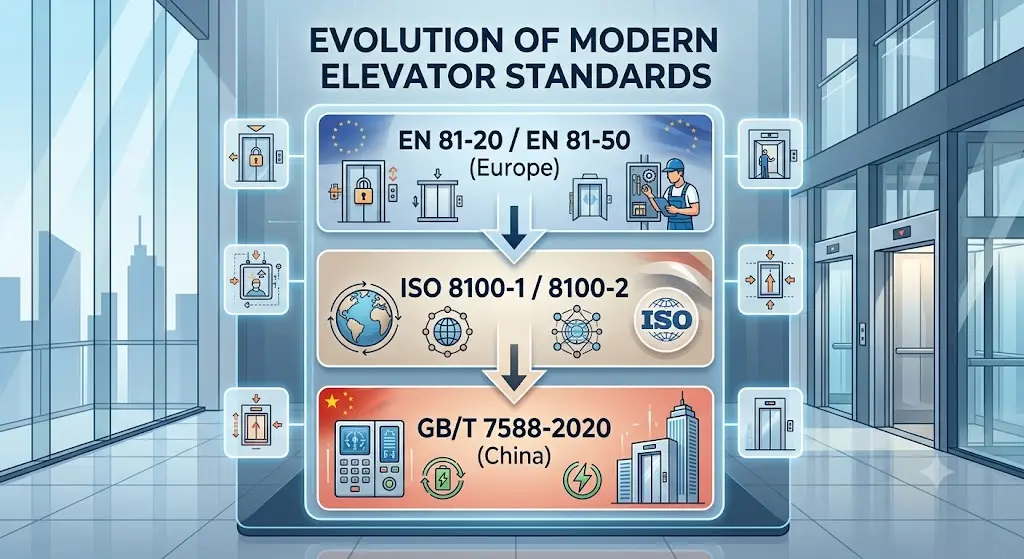
Relationship among major modern elevator safety standards.
Technically, the answer is no.
The misconception often arises because buyers confuse manufacturing quality with technical standards.
A safety standard defines minimum engineering requirements, including:
· Passenger protection
· Door system performance
· Braking systems
· Overspeed protection
· Electrical safety
· Structural strength
· Emergency rescue procedures
· Inspection and testing methods
Product quality, however, depends on factors such as engineering design, manufacturing consistency, quality control, component selection, installation, and maintenance.
Consequently, two elevators certified under the same standard may still demonstrate very different long-term reliability.
This distinction is frequently emphasized within the global elevator industry. Technical publications such as Elevator World have repeatedly noted that compliance with recognized standards establishes a safety baseline, while lifecycle performance depends largely on manufacturing quality, installation practices, preventive maintenance, and modernization strategies.
For international buyers, the more relevant questions are therefore:
· Does the supplier comply with the required national regulations?
· Can the manufacturer provide complete certification documents?
· Does the engineering design satisfy the project's code requirements?
· Can technical documentation support local authority approval?
These factors typically have a greater impact on project success than the manufacturing country itself.
| Standard | Primary Region | Published By | Main Application |
| EN 81-20 / EN 81-50 | Europe | CEN | European passenger and freight lifts |
| ISO 8100-1 / 2 | International | ISO | International harmonized safety framework |
| GB/T 7588-2020 | China | Standardization Administration of China | Chinese domestic market and export manufacturing |
| ASME A17.1 / CSA B44 | United States & Canada | ASME / CSA | North American elevator installations |
Although terminology and administrative procedures differ, these standards address essentially the same engineering objectives, including passenger safety, structural reliability, electrical protection, fire safety, inspection, and testing.
The most significant differences usually involve certification systems, local authority approval processes, accessibility regulations, seismic provisions, and country-specific building codes rather than fundamental safety philosophy.
International elevator projects rarely rely on a single technical standard alone.
Instead, engineers typically combine multiple requirements according to the project's location. A commercial building in Southeast Asia may specify GB/T 7588-compliant equipment while simultaneously requiring CE-certified safety components and locally approved fire emergency operation. A Middle Eastern high-rise may adopt EN 81 as the primary design basis while incorporating additional civil defense or accessibility regulations. Projects in Latin America often reference both European standards and national installation codes during final approval.
In practice, engineering teams spend considerably more time adapting documentation, calculations, and certification packages than redesigning the elevator itself.
Based on SURAPID's export experience across Asia, the Middle East, Africa, South America, and selected European projects, the technical platform of the elevator generally requires only limited modifications. The larger challenge is preparing complete compliance documentation for local authorities, including electrical schematics, structural calculations, safety circuit verification, material certificates, and commissioning records.
For example, during a commercial project in France, the core elevator design followed European technical requirements from the outset, while documentation and conformity assessment were prepared to satisfy CE compliance procedures before installation. In contrast, several commercial developments in the Middle East required additional local authority submissions despite using engineering principles substantially aligned with EN 81.
These examples illustrate an important reality of international elevator supply: successful project delivery depends not only on designing a compliant elevator, but also on demonstrating compliance through complete technical documentation and certification.
One of the most common misconceptions in international procurement is that compliance with a technical standard automatically authorizes an elevator for installation anywhere in the world.
In reality, technical standards and market certification are different requirements.
A standard defines how an elevator should be designed, manufactured, tested, and inspected. Certification demonstrates that a specific product complies with the regulatory requirements of the destination market.
For example:
· Elevators entering the European Economic Area generally require conformity with applicable EU legislation and CE marking.
· Eurasian Economic Union countries may require EAC certification.
· Gulf countries often require additional approvals issued by local authorities or civil defense agencies.
· North American projects typically follow ASME A17.1/CSA B44, together with local state or provincial regulations and inspection procedures.
Consequently, exporting elevators is not simply a matter of manufacturing equipment that satisfies one technical standard. Manufacturers must also prepare complete certification packages, including engineering drawings, structural calculations, electrical schematics, risk assessments, material certificates, inspection reports, and commissioning documentation.
Experienced international suppliers therefore build dedicated engineering teams capable of adapting documentation to each destination rather than treating every export project as a standard domestic installation.
While elevator technology has become increasingly standardized worldwide, every international project still requires project-specific engineering adaptation.
Typical adjustments include:
· Local electrical voltage and frequency
· Firefighter operation requirements
· Seismic design where applicable
· Accessibility regulations
· Machine room configuration
· Door dimensions
· Pit and overhead constraints
· Building management system interfaces
· Destination dispatch integration
· Local language user interfaces
These modifications rarely change the fundamental safety architecture of the elevator. Instead, they ensure that the system integrates correctly with local building regulations and operational practices.
This explains why experienced export manufacturers usually assign engineering resources during the quotation stage rather than after production begins.
International Elevator Delivery Process
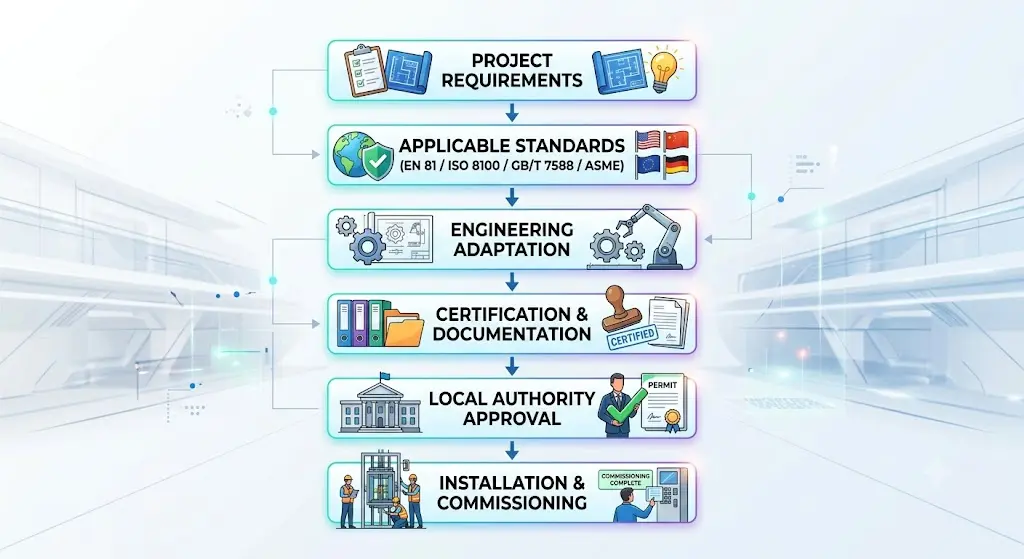
Typical compliance workflow for international elevator projects.
Across international projects, approval delays are seldom caused by the elevator itself.
More frequently, they result from incomplete technical documentation, inconsistent calculations, or certification packages that do not fully satisfy local authorities.
For example, during several commercial projects supplied by SURAPID in the Middle East, the elevator systems already complied with the required engineering specifications. However, additional submissions—including fire operation documentation, electrical diagrams, and authority-specific compliance forms—were required before installation approval could be granted.
Similarly, projects in Southeast Asia often combine internationally recognized safety standards with national building regulations and local inspection procedures. Successful delivery therefore depends not only on manufacturing quality but also on effective coordination between the manufacturer, consultants, contractors, inspection bodies, and government authorities.
This is one reason why experienced international suppliers invest heavily in engineering support, documentation management, and project coordination rather than focusing solely on production capacity.
Over the past two decades, elevator standards have gradually become more aligned.
The publication of ISO 8100 established an internationally harmonized framework derived largely from European safety requirements while allowing countries to implement national regulations suited to their own legal systems.
Future developments are expected to focus less on fundamental mechanical safety and more on emerging technologies, including:
· Digital maintenance records
· Remote diagnostics
· Cybersecurity for connected elevator systems
· Energy efficiency
· Predictive maintenance
· Smart building integration
· Accessibility enhancements
As buildings become increasingly intelligent, compliance will extend beyond mechanical design to include software, connectivity, and lifecycle management.
Manufacturers with strong engineering capabilities and international project experience will therefore be better positioned to meet evolving regulatory expectations.
Not word for word. However, GB/T 7588-2020 is largely aligned with ISO 8100, which itself is technically harmonized with EN 81-20 and EN 81-50. The standards share the same safety objectives, although certification procedures and regulatory implementation differ by country.
Yes, provided the complete elevator complies with applicable European regulations, undergoes the required conformity assessment procedures, and meets CE marking requirements where applicable.
No.
Every destination country has its own approval procedures, certification requirements, and inspection systems. Engineering documentation and regulatory compliance remain essential regardless of the manufacturing standard.
In many cases, it is not manufacturing but regulatory compliance.
Preparing complete technical documentation, obtaining certifications, and coordinating with local approval authorities often require more engineering effort than producing the elevator itself.
Not necessarily.
Safety standards define minimum engineering requirements rather than product quality. Manufacturing quality depends on engineering design, component selection, quality control, installation, maintenance, and long-term technical support.
Rather than focusing solely on the country of manufacture, buyers should consider:
· Engineering capability
· Compliance with required standards
· Certification experience
· Export project history
· Documentation quality
· Technical support throughout the project lifecycle
These factors generally have a greater influence on project success than manufacturing location alone.
Modern elevator standards have become increasingly harmonized through decades of international cooperation. GB/T 7588-2020, ISO 8100, EN 81, and ASME A17.1 all pursue the same objective: ensuring passenger safety through rigorous engineering, testing, and inspection.
For international projects, compliance involves more than designing an elevator that meets a particular standard. Successful delivery depends on adapting the system to local regulations, preparing complete certification documentation, and supporting approval throughout the project lifecycle.
As global construction continues to expand across regions with different regulatory frameworks, manufacturers capable of combining internationally recognized engineering standards with practical project execution will remain the preferred partners for developers, contractors, and elevator companies worldwide.
1. ISO 8100-1:2019 – Lifts for the transport of persons and goods — Part 1: Passenger and goods passenger lifts. International Organization for Standardization (ISO).
2. ISO 8100-2:2019 – Lifts for the transport of persons and goods — Part 2: Design rules, calculations, examinations and tests of lift components. ISO.
3. EN 81-20:2020 – Safety rules for the construction and installation of lifts – Passenger and goods passenger lifts. European Committee for Standardization (CEN).
4. EN 81-50:2020 – Design rules, calculations, examinations and tests of lift components. CEN.
5. GB/T 7588-2020 – Safety Rules for the Construction and Installation of Lifts. Standardization Administration of China (SAC).
6. ASME A17.1/CSA B44 Safety Code for Elevators and Escalators. American Society of Mechanical Engineers (ASME) & Canadian Standards Association (CSA).